
Fulton County Criminal Court Records
A Fulton County criminal court record is the court-maintained file for a prosecuted case. It is different from a sheriff booking record. The court record starts to matter when charges are filed or presented and the case begins moving through arraignment, motions, hearings, plea or trial, disposition, and sentencing. The Clerk of Superior and Magistrate Courts is the key record office for Superior Court criminal case records and Magistrate Court preliminary records.
Superior Court is the main Fulton County trial court for felony criminal cases in the Atlanta Judicial Circuit. State Court handles many misdemeanor criminal matters and traffic-criminal cases. Magistrate Court can show first appearances, warrant applications, bond activity, and preliminary hearings before a felony case moves into Superior Court. Municipal courts can issue bench warrants and maintain ordinance or local traffic matters outside the county criminal case search path.
The Fulton Clerk criminal matters page is a starting point for criminal filing and records context tied to the Clerk's office.
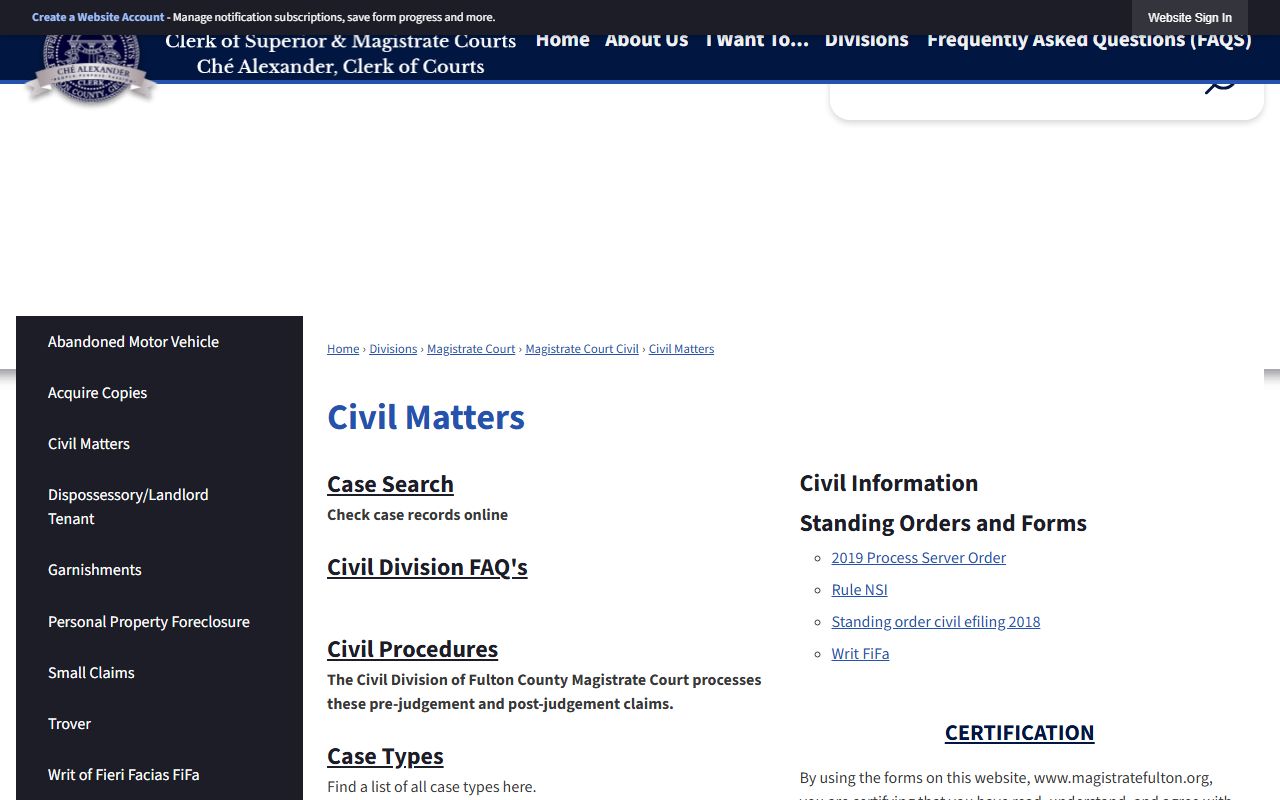
The Clerk's criminal page helps place Fulton County criminal court records in the correct office before a docket or certified-copy request is made.
Search Fulton County Criminal Records
For Superior Court criminal cases and Magistrate criminal-preliminary records, use the Fulton Odyssey Portal or re:SearchGA. Search by case number when known. If only a name is available, narrow the search by criminal case category, filing date, court location, and status. A jail roster entry can help identify a booking or charge, but the full criminal case file and final outcome belong in the court record.
- Identify whether the matter is felony, misdemeanor, traffic-criminal, warrant-related, or municipal.
- Search Fulton Odyssey by defendant name, case number, or attorney name.
- Use court, case category, date, and status filters to reduce false matches.
- Open the docket and read events in order from charge filing through disposition.
- Request a certified copy through the Clerk when a plea, sentence, order, or disposition must be official.
For statewide criminal history, the GBI criminal history and GCIC channel is separate from the Fulton County criminal court record. It may reflect arrests and criminal-history entries, while the court record shows case filings, hearings, pleas, dispositions, and sentences.
Fulton County Criminal Case Flow
Criminal court records should be read as a sequence. A charge may begin with an arrest, warrant, accusation, or indictment, but the court record becomes meaningful as events are filed in the case. Fulton felony matters can include Magistrate Court activity before Superior Court prosecution. Misdemeanors may remain in State Court, and city ordinance cases may remain in municipal court.
Case flow: Charges Filed › Arraignment › Pretrial / Motions › Plea or Trial › Disposition › Sentencing
| Stage | What Happens |
|---|---|
| Charges Filed | An accusation, indictment, complaint, warrant, or charging entry places allegations into the court record. |
| Arraignment | The defendant is advised of the charges and enters a plea, commonly guilty, not guilty, or nolo contendere. |
| Pretrial / Motions | Attorneys file requests, evidence issues are addressed, and hearings or status dates are scheduled. |
| Plea or Trial | The case resolves by plea, trial verdict, dismissal, or another disposition entered by the court. |
| Sentencing | The court records jail, prison, probation, fines, restitution, treatment, or other sentence terms after conviction. |
What Fulton Criminal Records Show
A Fulton County criminal court record can show the defendant, prosecutor, defense counsel, charge description, statute, offense date, arrest date, warrant number, indictment or accusation count, plea, disposition, sentence, probation, bond, and docket events. It may also show the judge, court location, hearing dates, courtroom, document links, and financial entries such as court costs, fines, restitution, or bond-related amounts.
| Field | What It Shows |
|---|---|
| Case Number | The criminal case identifier assigned by the court system. |
| Defendant | The person charged, with public identifiers limited by redaction rules. |
| Charges | Descriptions, counts, statutes, degree or level, offense dates, and amendments when public. |
| Plea | The formal response to a charge, such as guilty, not guilty, or nolo contendere. |
| Docket Events | Arraignment, motions, orders, hearings, continuances, verdicts, judgments, and appeals. |
| Disposition | The outcome of each charge or the case, such as guilty, dismissed, acquitted, or nolle prosequi. |
| Sentence | Jail, prison, probation, fines, restitution, treatment conditions, or other penalties. |
The Georgia Public Defender Council is relevant because Fulton criminal dockets may show appointed counsel or public-defense participation. Counsel listings help readers understand who appeared in bond, arraignment, plea, trial, or post-judgment events.

Public-defense information explains representation, but the court docket remains the source for filed case events and dispositions.
Fulton Charges vs Convictions
A charge is an allegation. A conviction is an outcome after a guilty plea, guilty verdict, or other judgment treated as a conviction under Georgia law. Fulton County criminal court records may list charges that were later dismissed, reduced, amended, or not prosecuted. A reader should not treat a charge line as a conviction unless the disposition supports that conclusion.
| Charge | Conviction | |
|---|---|---|
| Stage | Filed allegation or count. | Final outcome after plea, verdict, or qualifying judgment. |
| Proof level | May begin from probable cause or prosecutor action. | Requires a lawful plea, verdict, or court judgment. |
| Docket wording | May show pending, amended, reduced, dismissed, or nolle prosequi. | Should show guilty plea, guilty verdict, sentence, or conviction disposition. |
| Record use | Shows what was alleged. | Shows what the court resolved as guilt or punishment. |
For the charge-level path from arrest into a formal allegation, see Fulton County arrest records and court charges. That record is narrower than the full criminal case file and focuses on the allegations after arrest.
Dispositions and Sentences
Disposition is the outcome of a charge, claim, or case. In Fulton County criminal court records, a disposition may show guilty, not guilty, dismissed, nolle prosequi, acquitted, reduced, amended, transferred, or another court-entered result. The disposition must be read charge by charge because one case can have multiple counts with different outcomes.
Sentence entries can include jail, prison, probation, court costs, fines, restitution, treatment conditions, community service, accountability court participation, or post-sentence reporting requirements. Fulton Superior Court accountability court entries may appear when a treatment-based program affects review hearings, compliance, sanctions, incentives, graduation, or termination.
The District Attorney's role also shapes the criminal court record. Fulton County felony prosecution is handled by the District Attorney in the Atlanta Judicial Circuit, while many State Court misdemeanors are handled through Solicitor channels. Prosecutors may present charges, file accusations, dismiss counts, negotiate pleas, recommend sentences, or appear in accountability court matters. Defense counsel, including appointed counsel through Georgia public defender channels when a defendant qualifies, may appear in bond, arraignment, motion, plea, trial, and sentencing entries.
Note: Read each count separately because one Fulton County criminal case can contain dismissed charges and convicted charges.
Sealed vs Restricted Records
Georgia commonly uses the term record restriction for limiting public dissemination of eligible criminal-history information. Sealing is a court access limit for a file or document. Neither term should be treated as a promise that all traces disappear. Fulton County criminal court records may still be visible to courts, prosecutors, law enforcement, licensing bodies, or other authorized users in lawful circumstances.
| Sealed | Record Restricted | |
|---|---|---|
| Visibility | Public access to a file or document is limited by court order. | Public dissemination of eligible criminal-history entries is limited. |
| Main path | Motion, court order, or rule-based court procedure. | Georgia record-restriction process tied to arrest, charge, disposition, and agency records. |
| Best proof | Sealing order or docket entry. | Final disposition plus agency or court restriction result. |
| Limits | Some authorized users may retain access. | It does not erase every court record in every context. |
Access Fulton Criminal Court Records
Fulton County criminal court records are generally public unless sealed, restricted, juvenile, redacted, or otherwise protected by law. The Georgia Open Records Act supports access to many agency records, but court case files are usually requested through the clerk or court rather than a general county request. Georgia Title 15 court provisions assign court roles across Superior, State, Magistrate, Probate, Juvenile, and Municipal courts.
Juvenile records, adoption files, mental health matters, victim-safe addresses, full birth dates, Social Security numbers, financial account numbers, and sensitive family details may be blocked or redacted. If a criminal case is sealed, the public portal may show limited information or no public case. If the needed document is public but not online, the Clerk's office can provide copy, certification, or eCertification instructions.
Administrative records and criminal case records should not be mixed. A county open-records request may help with agency records, but the filed indictment, accusation, plea, order, sentence, and final disposition belong with the court clerk. Sheriff booking materials and incident records follow sheriff channels. State prison custody moves to the Georgia Department of Corrections after transfer, and federal prosecutions use Northern District of Georgia and PACER systems rather than the Fulton portal.